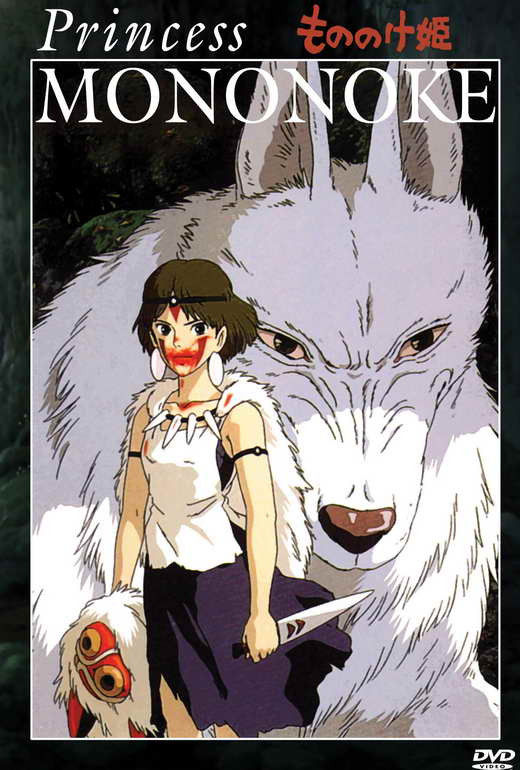
“Life is suffering. It is hard. The world is cursed. But still you find reasons to keep living.”
Princess Mononoke is a masterpiece. My first and favourite Studio Ghibli film.
Princess Mononoke tells the story of Ashitaka, a brave, young warrior-prince living in Feudal-era Japan (within the Muromachi period, roughly 1336 to 1573 CE) whose right arm becomes infected with a deadly curse that is spreading throughout his body, forcing him to permanently leave his home and family to find some treatment for his condition. Ashitaka travels to a small mining settlement in conflict with the spirits of a nearby forest and a wild adolescent girl named San. San despises the humans of the Iron Town and is willing to die in order to stop their deforestation of her home.
The word “Mononoke” itself refers to a type of vengeful spirit in Japanese mythology, and the title of Princess Mononoke refers to the character San, the titular Princess and deuteragonist, an orphaned girl raised by the wolf spirits of the woods.
Princess Mononoke has a central theme of man-versus-nature, or more accurately industry-versus-nature, but Mononoke does not depict the forces of nature and industry as either exclusively good or bad. Both sides in this conflict are flawed, dangerous and justified in their actions, as outsider protagonist Ashitaka is able to observe, moving between the town and the primeval forest as a self-appointed mediator, whose stated goal is “To see with eyes unclouded by hate.”
The mining town is destroying ancient forests, but the wealth gained goes towards helping disadvantaged people. Mining profits are used to free brothel workers and helping other "undesirables," like lepers, during a time of civil war and widespread strife in Japan. The Gods and spirits of the forest can be friendly to humans, but they are mostly indifferent to their sufferings, and resent mankind’s encroachment and their deadly new iron-based technology – firearms. The common people are just trying to get by in a dangerous world filled with war, disease, poverty, famine, and environmental issues to boot.
Ashitaka is shown repeatedly struggling to control his dominant arm as a result of the curse, which resonates stronger with me now that I have words for things I have struggled with my whole life, words like dyspraxia. Ashitaka has to find someone who might be able to help him with his disabling condition by himself, as his family are unable to help, which is a sad but familiar story to many with chronic conditions.
Ashitaka does manage to get some help from San. Their relationship is not a typical movie romance; the first time the Prince sees the Princess, her face is covered in animal blood and she tells him to leave the forest. When they meet again, Ashitaka is shot by a villager of Iron Town for protecting San, and then one of San’s wolf siblings mauls Ashitaka when he brings San back to the forest.
Over the course of the film, the two humans help each other with their own struggles, physical and emotional, but Ashitaka doesn’t ‘get’ the girl in the traditional sense. Instead they find reasons to keep living, despite the hardships and difficulties they both face. Ashitaka decides to live in the town and San stays in the forest, but Ashitaka promises to visit her whenever he can – it’s the start of a relationship, not the culmination of one.
People often talk about their favourite Disney princesses, but they were never my speed. I’m a fan of the semi-feral, Eco-terrorist who was raised by wolves. There’s no contest between San and those royals, Princess Mononoke would wipe the floor with them.
Can a forest heal like a human heart? Can pain and hatred give way to love? Can you get along with your in-laws if they are all giant wolves? Watch it and come to your own conclusions.
Review by Devon Trahan
5 Out of 5